Angular Rate Sensor
The next example demonstrates how to model and simulate a single-axis angular rate sensor in the i-ROM MODELBUILDER environment. All model items are defined in the “Gyroscope.irommod” input file which can be found in the “Gyroscope_UsersManual” project folder. Angular rate sensors are often referred to as gyroscopes.
The angular rate sensor in Figure 1 consists of 6 mass bodies, 12 anchors, 132 connecting springs and 16 combcells for electrostatic actuation, capacitive sensing, and quadrature compensation. It is a z-axis gyroscope, which means the sensor detects angular rates (angular velocities, speed of rotation) around the vertical axis. In case of positive angular rates, the sensor rotates counterclockwise with its housing as marked by the red arrow. The speed of rotation will be measured and provides the output signal of the MEMS sensor product.
Capacitive micromechanical sensors transform the quantity to be measured into mechanical forces, forces create mechanical displacements and displacements provide the capacitance change for the electronic signal evaluation unit (ASIC). Inertial forces are utilized for accelerometers and Coriolis forces are widely used for angular rate sensors.
In rotating systems, Coriolis forces appear on moving masses which have non-zero velocities. For this reason, angular rate sensors need actuator components which permanently drive one or multiple mass bodies at a constant vibration amplitude. Therefore, MEMS based angular rates sensors are often referred to as “Vibratory gyroscope” in literature.

Figure 1. Single-axis angular rate sensor with drive velocities and Coriolis forces.
From the physical point of view, the Coriolis force vector \(\vec{F}_c\) acting on a seismic mass \(m\) is proportional to the angular rate vector \(\vec{\Omega}\) (input signal) and depends on the velocity vector \(\vec{v}\) of the oscillating mass.
In the example of Figure 1, the green “Drive frames” are stimulated by electrostatic forces at the attached combcells referred to as “DAU - Drive Actuation Units”. The DAU create an antiphase oscillation in uy-direction. Figure 2 shows a snapshot in time where the right drive frame moves upwards, and the left drive frame moves downwards. Caused by the spring design, the red “Coriolis frames” in Figure 1 follow the drive motion with almost identical amplitudes but the orange “Sense frames” rest at the initial position.

Figure 2. Scaled drive mode amplitudes of the angular rate sensor.
If the gyroscope rotates around the z-axis, an angular rate \(\Omega_Z\) appears which creates tiny Coriolis forces at the “Drive frames” and at the “Coriolis frames”. In the same snapshot in time, the Coriolis forces point antiphase in ux-direction as marked by the orange arrows in Figure 1 and create motion as shown in Figure 3.

Figure 3. Scaled sense mode amplitudes of the angular rate sensor.
Due to the spring design, the Coriolis forces at the “Drive frames” are without effect. The “Drive frames” are constraint in sense direction and can’t move in ux-direction.
In contrast, the Coriolis forces generated at the “Coriolis frames” drive both, the “Coriolis frames” and the “Sense frames” with almost identical amplitudes in sense direction. Ideally, the “Drive frames” move only in drive direction and the “Sense frames” move only in sense direction. Crosstalk between drive and sense is strongly reduced by the six masses design of the given example.
Finally, the sense motion is transformed into a capacitance change at the inner combcells of the “Sense frames”. Those combcells are referred to as “SMU – Sense Measurement Units” in the following sections.
The anchors of the SMU-combs are linked by interconnects to the voltage ports “V_SMU+” and “V_SMU-” which provide the differential sensor output ports for the electronic signal evaluation unit (see Figure 4).

Figure 4. Interconnects for sensing and combcells for quadrature compensation.
In real MEMS devices, the drive motion in uy-direction couples slightly to the sense motion in ux-direction. This crosstalk is mainly caused by asymmetries originated from manufacturing tolerances such as etch sidewall slopes, misaligned springs or misaligned combcells.
Even in the absence of angular rates, the crosstalk of real-world gyroscopes produces a signal offset known as “Quadrature”. The offset can be compensated by electrostatic forces at asymmetric combs referred to as “QCU – Quadrature Compensation Units” (see Figure 4). Several other layouts are published in literature.
QCU-combs generate electrostatic forces in sense direction which depend linearly on displacements in drive direction. The magnitude of forces can be scaled by DC-voltages. Depending on the sign of the offset, DC-voltages are either applied at the “QCU+” or at the “QCU-” combs. In practice, the voltages are slowly increased until the signal offset disappears.
Model generation procedure⚓︎
The model generation procedure is similar to the acceleration sensor example discussed earlier. Details of the current design can be found in the model input file “Gyroscope.irommod”. The angular rate sensor consists of six mass bodies. The reference numbers are shown in the left and right upper corner of Figure 5. Furthermore, three different types of combcells are used for the DAU, the SMU und the QCU-capacitances.
In practice, drive motion amplitudes stimulated at the DAU-combs are designed to be relatively large. Typical values are between 4 and 20 µm. Combcells of type “area” (area variation) are widely used for actuation of gyroscopes.
Sense motion amplitudes detected at the SMU are small, typically less than 0.1 µm. Combcells of type “dif1” or “dif2” (gap variation) are preferred for differential sensing of angular rates.
Finally, QCU-capacitors need to be asymmetric to create the desired force-displacement-relationship. The type “asym” has been set for demonstration (see COMB command).

Figure 5. Top view on the angular rates sensor, the coupling springs and the comb cells.
Default and user defined colors can be assigned to each seismic mass in the “Color Settings” window of the GUI. The coloring helps to clarify the operating principle in simulation models and result plots. Further annotation symbols can be activated in the “Model Tree” window. The colors are likewise transferred to the finite element tool ANSYS® or COMSOL® if a model export is activated by the “ANSYS Export” or “COMSOL Export” icon.
Modal analysis and electrostatic softening effects⚓︎
Simulations usually start with a “Modal analysis” to adjust the eigenfrequencies into a range of interest. In this example, the drive and sense frequencies should be between 20 kHz and 25 kHz whereby the sense frequency is often designed to be a few percent higher compared to the drive frequency. Finding appropriate dimensions is a major challenge in conceptual design.
After some changes of geometrical parameters, the drive mode frequency has been set to 21.2 kHz and the sense mode frequency to 22.0 kHz. Obviously, the length of horizonal beams affect the frequency of the drive mode and the length of vertical beams the frequency of the sense mode in ux-direction.
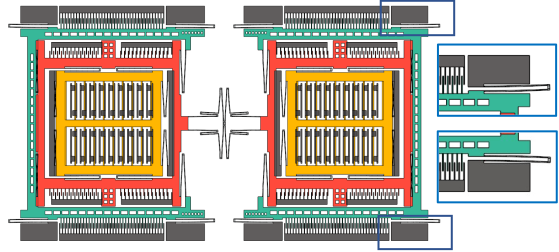
A modal analysis of the mechanical domain shows that mode #1 and #2 are inphase (common) modes and mode #3 and #4 are antiphase operating modes (see Table 1). The frequency spacing between inphase and antiphase modes can be adjusted by the stiffness of the cross-shaped coupling spring at the center.
Frequently, angular rate sensors make use of “Mode-matching” principles of operation. “Mode-matching” means that both operating modes must have the same eigenfrequency in order to exploit resonance amplification for drive and sense motion at the same time.
Identical frequencies are difficult to realize because of manufacturing tolerances. To overcome the problem, the sense mode frequency is usually designed a few percent higher as the drive frequency. During operation, the sense mode is tuned down by electrostatic forces until the eigenfrequencies are nearly identical.
For demonstration, the SMU-combs are exploited for frequency tuning. The command sequence to calculate the tuned eigenfrequencies is listed in the right of Table 1. Mode-matching occurs at DC-voltage of about 10.4 V. In practice, separate tuning combs are usually attached to the system which are referred to as “FTU – Frequency Tuning Unit”.
Highly enlarged anti-phase sense mode:
|
|
|
|
|
|
Table 1. Modal analysis results of the angular rate sensor with tuning effects.
Result plots in Table 1 indicate that “Drive frames” are not perfectly constraint in ux-direction. The horizontal beams in the blue boxes move up and down a little. It allows the green “Drive frames” to move slightly in sense direction and affects the sensor performance. It illustrates that numerical simulations are important to quantify imperfections of sensor and actuator components. A connecting bar between the ends of the upper and lower springs would strongly reduce this unwanted motion component and could improve the sensor performance.
Figure 6 shows the finite element model which has been generated by ANSYS® export features to validate the accuracy (see Interface to ANSYS®).
High-order modes are designed to be about 5 times larger as the drive mode to avoid modal interactions due to non-linearities. From the physical point of view, even tiny non-linear effects stimulate harmonics (2f, 3f, …) of the drive frequency. Disturbing resonant oscillations can occur if such a frequency is equal to a high order eigenmode. Therefore, the first harmonics of the drive mode should be compared carefully with other eigenfrequencies obtained in a modal analysis. The higher the frequencies the smaller are the amplitudes and consequently the disturbing effect.

Figure 6. Finite element model export of the angular rate sensor to ANSYS.
Static analysis and DC-sweep⚓︎
“Static simulations” are necessary to calculate primary sensor parameters such as the required drive voltages, the expected sense displacements and the related capacitance change for given angular rates. Furthermore, static simulations are helpful to estimate the sensitivity of the sensor to external accelerations, to vibrations or overload situations.
During operation, angular rate sensors oscillate continuously with a well-defined and permanently controlled amplitude in drive direction. Exemplarily, an amplitude of 4 µm should be reached in resonance. Assuming a quality factor of 200, it requires a quasistatic displacement amplitude of 20 nm at the “Drive frames”. To actuate the system, DC- and AC-voltages must be applied at the DAU-combs to create anti-phase drive oscillations.
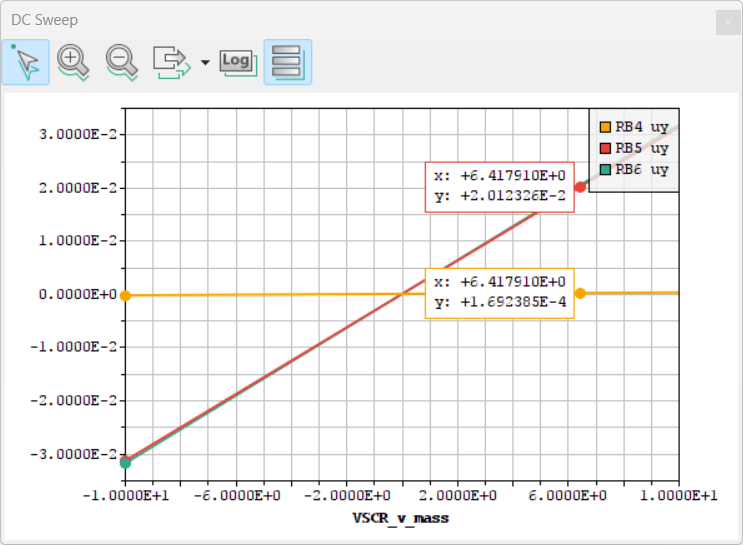
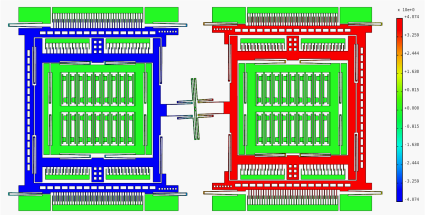
The DC-voltages are set to ±21 V. The required AC-voltage is calculated by a sweep operation as shown in the right column of Table 2. A sweep range from -10 V to +10 V is specified by the DCSW command. About 6.4 V are necessary to reach 20 nm amplitudes at the “Drive frames” and “Coriolis frames” as shown by the green marker in the voltage-displacement-relationship. The contour plot below is scaled by a factor of 200 in order to visualize the drive amplitudes in resonance.
|
Voltage-displacement-relationship:
|
uy-displacements at 6.4 V (sample #165, 200 times enlarged):
|
|
Table 2. Drive mode simulation results (voltage-displacement-relationship).
In a next simulation run, the sense mode amplitudes and the capacitance change shall be analyzed for a nominal angular rate of 20 rad/s. It corresponds to 1150 degrees per second or about 3.2 turns per second.
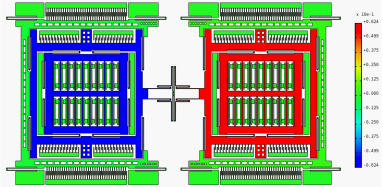
The DRIV command is utilized to assign 4 µm amplitudes to the drive eigenmode. Next, the OMEG command defines the nominal angular rate around the z-axis and finally, SOLV, stat; calculates the static displacement amplitudes. The “Sense frames” move about 0.24 nm. Assuming a quality factor of 100, the displacements become 24 nm in resonance.
|
|
Table 3. Static sense mode simulation results for given angular rates.
The fixed fingers of the SMU-combs form a differential capacitor to transduce sense motion amplitudes into capacitance changes. It can be seen in Table 3, that the SMU-combs are mirrored around the y-axis to superimpose the capacitance change of anti-phase motion components. The comb fingers which are connected to the “V_SMU+” voltage ports are referred to as “SMU+” capacitances and the comb fingers connected to the “V_SMU-” ports are referred to as “SMU-” capacitances. The initial capacitances for both are about 270.8 fF.
In contrast to displacements, the capacitance changes obtained in static simulations can’t simply be multiplied by the quality factor to get results at resonance. Combcell capacitances based on gap variation scale non-linear with displacements.
For this reason, a second simulation run has been performed where the angular rate signal was multiplied with the quality factor. The resulting capacitance changes at 61.2 nm displacement amplitude become +7.40 fF at the “V_SMU+” and 7.00 fF at the “V_SMU-” ports. Both values are calculated for positive amplitudes and switch values for negative amplitudes of the sinusoidal oscillation. The average capacitance change is 7.20 fF.
Harmonic response analysis (AC-sweep)⚓︎
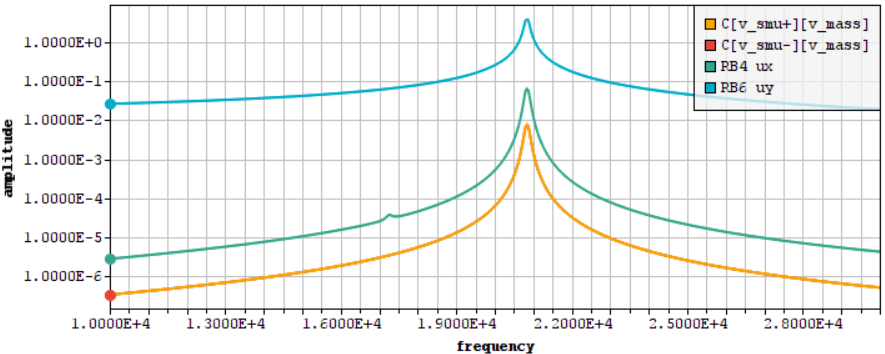
While the static analysis covers only the low frequency range, the “Harmonic analysis” precisely describes amplitudes and phase angles for all frequencies. In the following example, the results of the static simulations are compared to the harmonic response for the “Mode-matching” (a) and the “Mode-splitting” (b) approach.
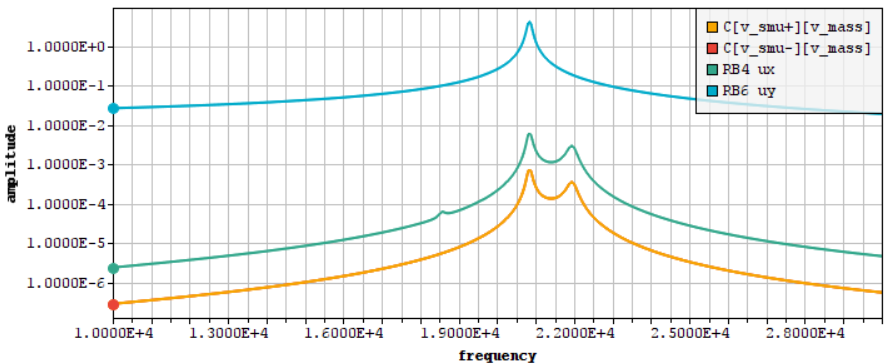
Table 4 lists the command sequence for the harmonic response analysis. On the right is the amplitude-response for the drive mode (RB6 UY), the sense mode (RB4 UX) and the capacitance amplitudes at voltage ports “v_sen+” and “v_sen-” with regard to “mass”. Values for DC- and AC-voltages and the value for the angular rate are taken from the previous static simulation runs.
The modal superposition solver must be activated by the MSUP command because the quality factors for drive and sense strongly differ. A quality factor of 200 for the drive mode and 100 for the sense mode correspond to damping ratios of 0.0025 and 0.005 respectively. The quality factors for all other modes are set to 100. Damping ratios are assigned to modes by the MDMP command. Rayleigh damping defined by RDMP could fail because frequencies with strongly different damping ratios for drive and sense are very close together. Negative alpha-beta-multiplier might appear and can cause problems. Constant damping defined by CDMP does not allow different damping for drive and sense modes.
The lower bound of the frequency range is 10 kHz and the upper bound is 30 kHz. 5000 steps are calculated in between with a logarithmic data point spacing. Simulations are started by the SOLV, harm; command and take just a few seconds.
The response for the “Mode-matching” approach agrees well with static results. The reason for small deviations between static and harmonic simulation results was already discussed for the accelerometer example.
The only difference to static simulation results is that the “SMU+” and “SMU-” capacitance functions in Table 4 show the same amplitudes. A harmonic response analysis linearizes all system equations at the operating point. Hence, capacitance amplitudes are calculated from the capacitance derivatives multiplied by displacement amplitudes. In a harmonic response analysis, the capacitance amplitudes for positive and negative displacement amplitudes are inherently the same.
|
a) Frequency tuning (Mode-matching):
|
b) Separated drive and sense mode (Mode-splitting):
|
Table 4. Harmonic response analysis results with and without frequency tuning.
In the next simulation run, the tuning voltages have been reduced from 10.4 V to 2.08 V. Frequency tuning is strongly reduced and the drive and sense mode frequencies are separated by a few percent referred to as “Mode-splitting” approach. The harmonic response for the “Mode-splitting” condition is shown in case b). The sense mode shows two peaks, one at the drive frequency and one at the sense frequency.
At the marked drive frequency of 21.2 kHz, the sense mode is not in resonance and much smaller amplitudes and capacitance changes can be observed. As a result, the sensitivity of the gyroscope is much lower compared to case a).
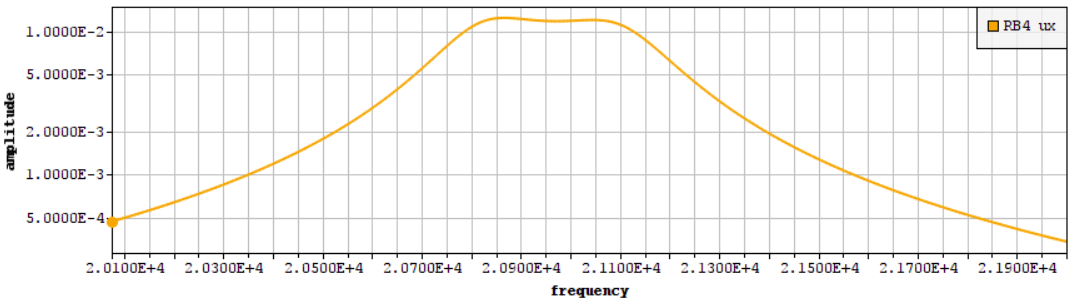
“Mode-matching” allows for a very high sensitivity but usually the bandwidth of the sensor is small caused by high quality factors. The bandwidth can be enlarged if the response curve of the sense mode shows a high but also flat plateau. It is very difficult to realize in practice. In Table 5, the displacements are reduced but the flat plateau spans now about 100 Hz. Angular rates with a frequency of about 50 Hz can be measured with high accuracy if the drive frequency is set at the center of the plateau.
|
Sense amplitude for mode-matching (frequency tuning):
|
Table 5. Sense motion response showing a large amplitude and bandwidth.
Transient simulations⚓︎
The harmonic response analysis calculates the stationary amplitude and phase angle of system quantities for given frequencies. “Transient simulations” in the time domain provide supplementary information about the system’s response but are more resource consuming.
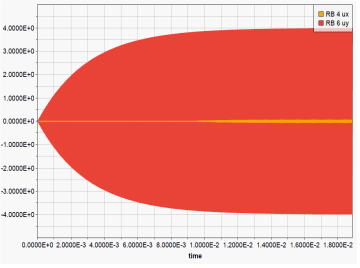
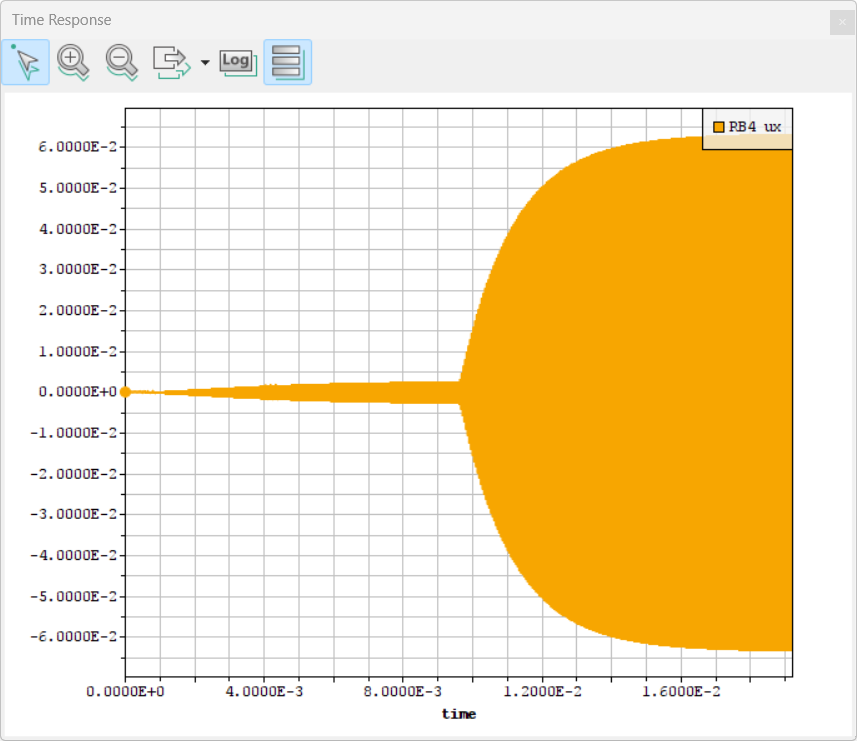
For sine-, step-, pulse-, or ramp-functions, the transient simulations calculate how long it takes until the stationary state is reached. For angular rate sensors, engineers are interested in the settling time of the drive and sense mode after load functions act on the system or change their values. For low damped systems, the settling time (95 % of the peak value) is roughly the quality factor divided by the eigenfrequency of the mode. For the given example, the drive mode takes about 10 ms and the sense mode about 5 ms to reach the stationary state. The following transient simulation reproduces the expected response.
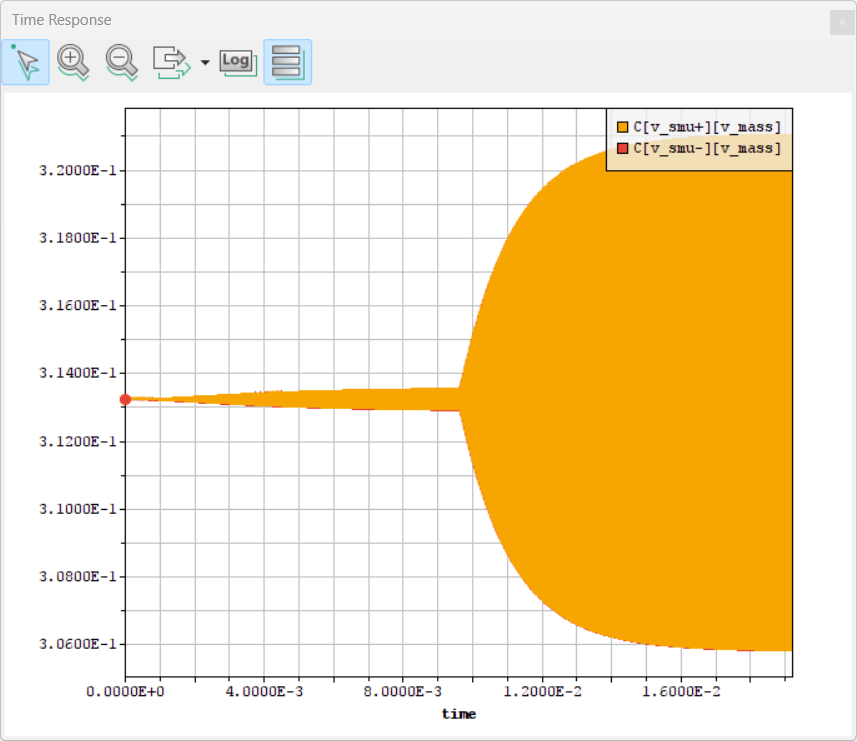
In Table 6, the drive mode is stimulated at the DAU-ports with a sinusoidal voltage load at its eigenfrequency. Due to a quality factor of 200, the expected settling time is about 200 cycles. The angular rate function is defined by a pulse function. The high-pulse starts after 200 cycles (at about 9.5 ms) and it takes 100 cycles to reach the stationary state (at about 15 ms). The total simulation time is 400 cycles whereby 100 time-steps have been set for each period (see TIME command).
Stationary displacement amplitudes for drive and sense correspond to the results of the harmonic response analysis. The capacitance-time-functions at the SMU-combs show the expected asymmetry as discussed in the static simulation section. Transient simulations are solved iteratively and provide accurate results for non-linear effects. In this example, the initial SMU-capacitances are 270.8 fF, capacitances for positive sense amplitudes become 278,2 fF and for negative amplitudes 263.7 fF. Hence, the capacitance changes are +7.4 fF and -7.1 fF.
|
Drive and sense displacements over time:
|
Sense displacements at mass body #4:
|
Capacitance-time-functions at SMU:
|
Simulink model export:
|
Sense displacements for mode-splitting:
|
Table 6. Transient simulation results for mode-matching and mode-splitting.
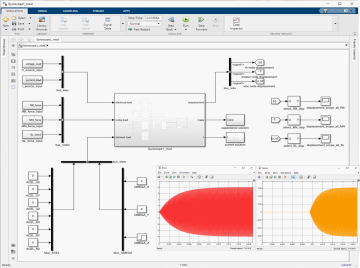
In a next step, the transient simulation model has been exported to SIMULINK (see Interface to SIMULINK®). All simulation settings are automatically transferred to the signal-flow models. The SIMULINK export is activated by clicking on the “Simulink Export” icon of the Graphical User Interface. SIMULINK simulation results are identical. SIMULINK models are more flexible to use. It is possible to apply arbitrary load functions, to modify system model features and to monitor internal simulation quantities as discussed earlier.
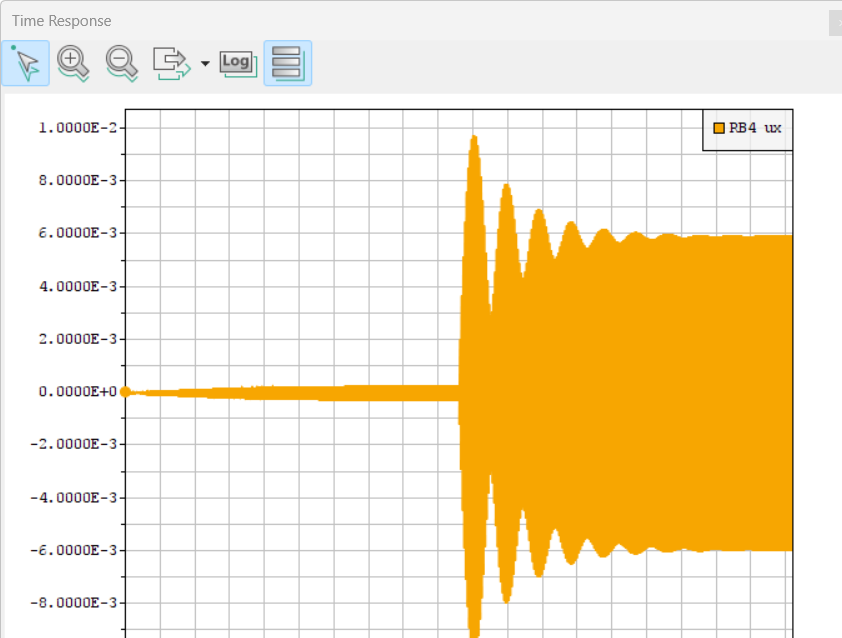
The right lower picture of Table 6 shows sense displacements for the “Mode-spitting” condition. In this graph, the SMU-voltages have been reduced from 10.4 V to 2.08 V. Amplitudes correspond to results of the harmonic response analysis. So far, the ideal system has been considered without imperfections.
For demonstration, the DAU-combs are misaligned with an offset of 10 nm by the “asym_g” parameter in the Design Variables window of the GUI. The fixed fingers of the upper DAU-combs are shifted 10 nm to the right, and the fixed fingers of the lower DAU-combs are shifted 10 nm to the left. At zero angular rates, the sense mode is slightly stimulated due to the asymmetry. In the given design, the misaligned DAU-combs create small electrostatic forces in sense direction depending on displacements in drive direction.
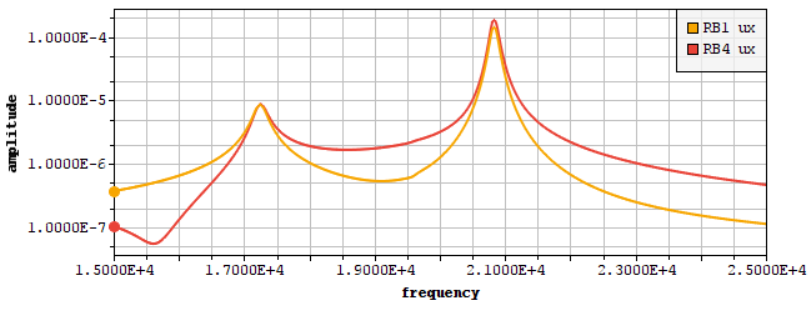
The unwanted sense motion components can be suppressed by electrostatic forces acting in opposite direction. In this example, a quadrature compensation voltage of 3.0 V has been applied at the “QCU-” combs shown in Figure 4. The voltage at the “V_QUD-” ports create an anti-resonance at 20.61 kHz and cancels sense motion components in ux-direction. Commands for the harmonic response analysis and simulations results can be seen in Table 7. The higher the voltage has been set, the more moves the anti-resonance to lower frequencies.
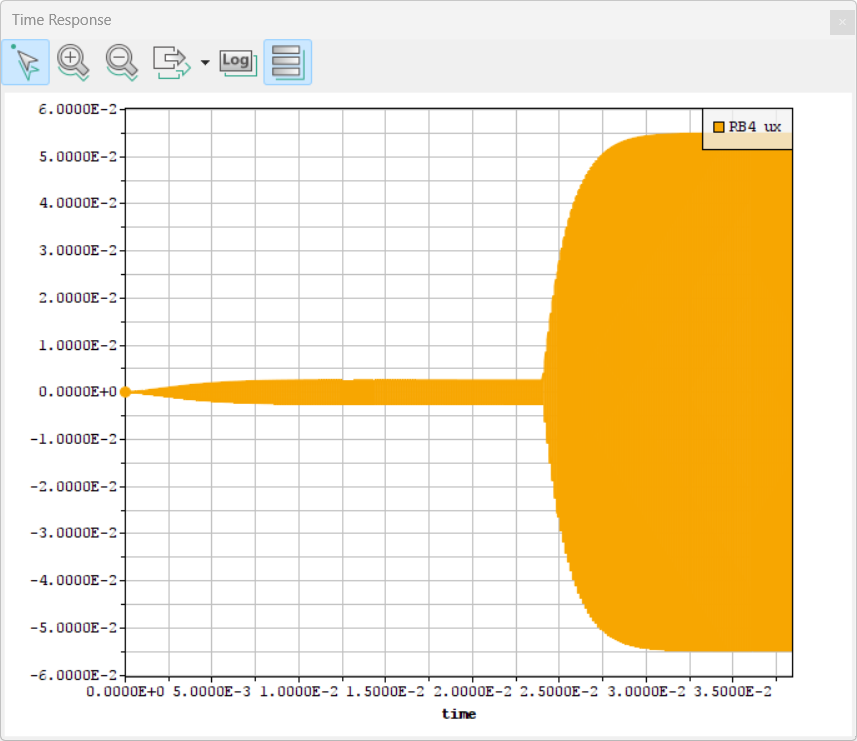
The frequency of the anti-resonance is the new operating point where quadrature signals are canceled out for a great part. Consequently, the drive frequency has been set at 20.61 kHz in subsequent transient simulations. In the first run, the “QCU-” voltage is set to zero in order to visualize the transient response without quadrature compensation. The sense signal amplitude due to quadrature is 0.28 nm and the signal with additional angular rate becomes 1.13 nm. Sense amplitudes are much smaller because both, the drive mode and the sense mode, are not in resonance.
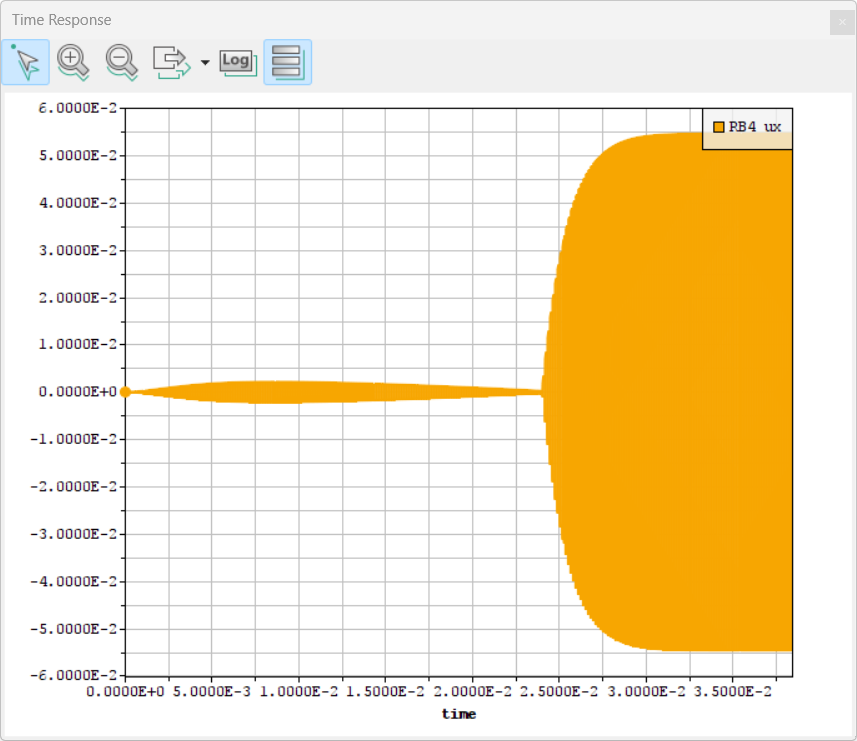
In the next transient simulation run, the “QCU-” voltage is lowly ramped from 0 V to 3.0 V. The sense motion component caused by quadrature is continuously reduced to about 0.028 nm. If the “QCU+” would be ramped by a DC-voltage, the sense motion amplitudes continuously increase, and the signal offset would worsen even more.
Quadrature compensation at resonance is more difficult to analyze because the phase shift must be considered too. More details can be found in literature.
|
Harmonic response with quadrature compensation:
|
Transient response without quadrature compensation:
|
|
Transient response with quadrature compensation:
|
Table 7. Transient simulation schema to compensate quadrature effects.