Micro Mirror Actuator
The next example demonstrates how to model and simulate a micro mirror actuator. All model items are defined in the “Mirror.iromproj” input file which can be found in the “Mirror_UsersManual” project folder. Micro mirrors and micro mirror arrays are widely used for image projection systems, for spectrometer applications and optical object recognition or position tracing systems.
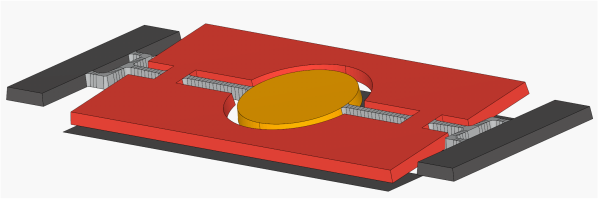
The micro mirror example shown in Figure 1 is designed for resonant light deflection applications and can be used for the line-scan in image projection devices. The resonant frequency of the optical area is 24 kHz and the optical scan angle is about ±3.5°. The micro mirror is based on a two-mass system whereby the red mass body forms the “Drive Actuator Unit (DAU)” with two parallel plate capacitors underneath and the orange mass forms the optical area for light deflection.

Figure 1. Schematic view on the model components of the micro mirror actuator.
In order to achieve large scan frequencies, an anti-phase torsion mode is used for the given example. The first eigenmode of the micro mirror is the common mode whereby the inner and outer mass bodies tilt almost synchronously around the rx-axis. The second eigenmode is the anti-phase operating mode. Its frequency is about 4 times larger as the frequency of the common mode. The tilt amplitudes of the inner and outer masses are designed to be strongly different.
For the given dimensions, the tilt amplitude of the optical area is about 26 times larger as the tilt amplitude of the outer mass used for actuation. The ratio of the tilt amplitudes can be controlled by the mass moments of inertia of the moving masses.
A large amplitude ratio of the tilt angles is very important for the performance. A small tilt at the actuator mass allows for relatively narrow electrode gaps to the underlaying parallel plate capacitors. At narrow gaps, the applied voltages create large electrostatic forces which strongly actuate the anti-phase oscillation mode. In practice, the amplitudes of the drive mass can exploit almost the entire electrode gap without showing any pull-in effects since the system is driven in resonance. The small tilt amplitudes of the actuator mass couple through the inner springs to the orange mirror plate and create 26 times enlarged amplitudes. The amplitude ratio is defined by the rx-tilt DOF results of the anti-phase eigenvector. Underneath of the optical mirror must be a deep cavity.
A deep cavity is necessary for two reasons. First, to avoid a mechanical contact to the substrate surface and second to lower damping in order to obtain a significant resonant amplification of the anti-phase operating mode. In the present example, squeeze-film damping occurs mainly at moving plates with large amplitudes. For the anti-phase operating mode, it is the inner mass which contributes most to viscose damping. In that region, the gap to the substrate is large and a quality factor of 1000 is assigned to the anti-phase tilt mode in the following.
For the common mode, it is mainly the outer mass which has large amplitudes. Since the electrode gaps at the outer mass are much smaller, a quality factor of 100 has been assigned to the common mode. The quality factors of all other modes are likewise set to 100 for demonstration. Proper damping data can be obtained from squeeze-film simulations in finite-element tools or from analytical equations published in literature.
Model generation procedure⚓︎
The actuator mass shown in red is defined by five primitives (see “Mirror.irommod” file). It starts with a rectangle defining the outer dimensions of the mirror plate. The second command cuts a circular hole at the center by Boolean subtraction. Finally, three rectangular primitives are used to cut the openings for the connecting springs. The inner mass is defined by a single circular primitive.
The suspension springs are modeled by 16 connecting points and 12 linking spring elements. The C-shaped connections at the anchors are valuable to reduce the influence of package stress on the micro mirror. Two master nodes are assigned at the actuator mass and two master nodes at the mirror mass as shown in Figure 2. The master nodes are utilized to monitor displacements at the outer edges.
Both, the upper and the lower “Drive Actuator Unit (DAU)” are defined by three rectangular plate capacitors using the PCAP command. The “DAU+” and “DAU-” capacitances are automatically combined to a single capacitance since the same label has been set for all three plate elements.
Parallel plate capacitors can be larger as the moving masses. Furthermore, Boolean operations are utilized for complicated shapes of plate capacitors. The MODELBUILDER recognizes the overlapping area and considers in-plane and out-of-plane motion components for accurate capacitance calculations.
The right lower picture in Figure 2 shows the exported finite element mesh of the mirror example (see Interface to ANSYS® ).

Figure 2. Graphical visualization of characteristic model items and the FE-mesh.
Modal analysis and electrostatic softening effects⚓︎
The “Modal analysis” calculates the eigenfrequencies and eigenvectors of the micro mirror example. In practice, a high DC-voltage is applied at the bottom plate capacitors and the mirror is driven by a superimposed AC-voltage applied at the functional layer with its masses. The DC-voltage is set +200 V at the “V_DAU+” port and -200 V at the “V_DAU-” port.
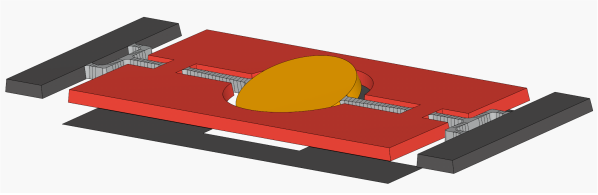
Table 1 shows the eigenfrequencies of the mechanical domain and the tuned frequencies at applied DC-voltages. It can be seen, that modes with out-of-plane motion components at the actuator mass change their eigenfrequencies. It is mainly mode #1 but also mode #2 has a slightly reduced eigenfrequency. Mode #1 is the common mode with a tuned frequency of about 4.8 kHz. The frequency shift is about -22 %. The anti-phase operating mode #4 has a frequency of 25 kHz.
The amplitude ratio for rx-tilt can be calculated from the eigenvectors of both mass bodies which are listed in the output plot of the “Solution Item Selection” panel.
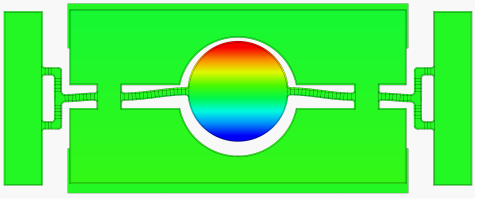
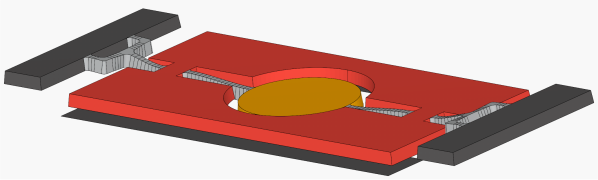
Mode #3 is the common mode in uy-direction. The colors in the contour plot show uz-displacements which are caused by the highly enlarged etch sidewall angles. The right lower picture shows mode #6 with out-of-plane motion components.
The geometrical dimensions have been adjusted to realize 24 kHz oscillation frequencies. If the deflected light beam of the mirror illuminates two lines in each cycle, one in the forward direction and one in backward direction, it leads to 48 thousand scanlines per second. Hence, images with 1000 lines can be projected with a frame rate of 48 pictures per second.
|
|
||||
|
|
|
|||
Mode #1, common mode, rx-tilt:
|
Mode #3 with uz-displacement contours:
|
||||
Mode #4, anti-phase mode, rx-tilt:
|
Mode #6, common mode, uz-displacements:
|
||||
Table 1. Modal analysis results with and without electrostatic softening effects.
Static analysis and DC-sweep⚓︎
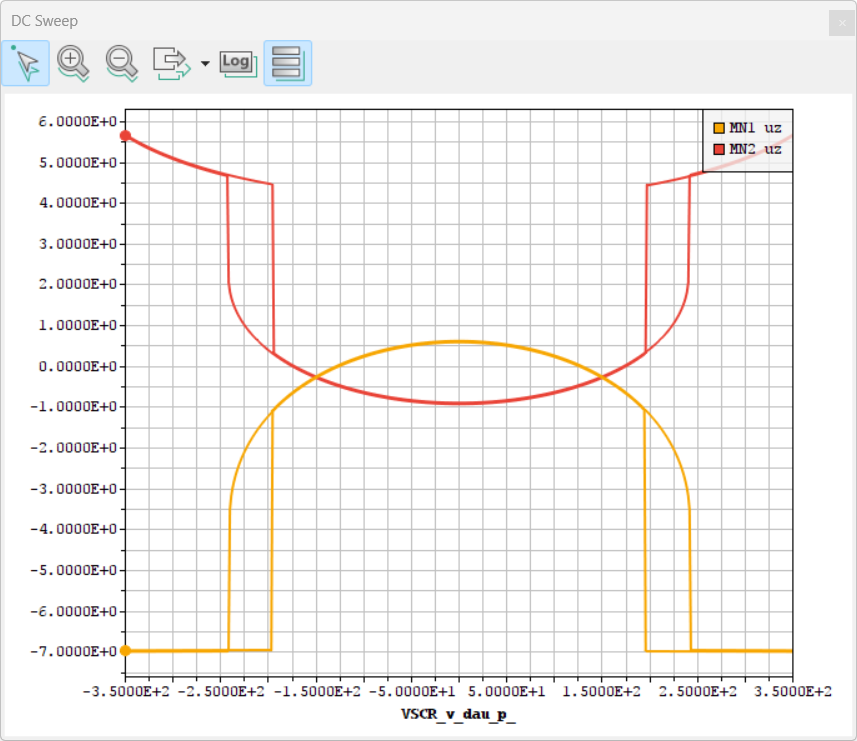
For micro mirror applications, “Static and DC-sweep simulations” are used to calculate the voltage-tilt-relationship. There are two different ways to drive the micro mirror during operation. In the simplest case, a voltage is applied at only one conductor as shown in the left column of Table 2.
Independent on the sign of the applied voltage at the “DAU+” port, the parallel plate capacitor creates attracting forces and the mirror tilts in just one direction. The “DAU-” port must be activated to tilt the mirror in the opposite direction which is costly in practice. Another drawback is that the voltage-tilt-relationship is a parabolic function even for small deflection angles. The voltage-tilt-relationship is non-linear and requires additional effort for controller circuits.
|
|
uz-displacement
|
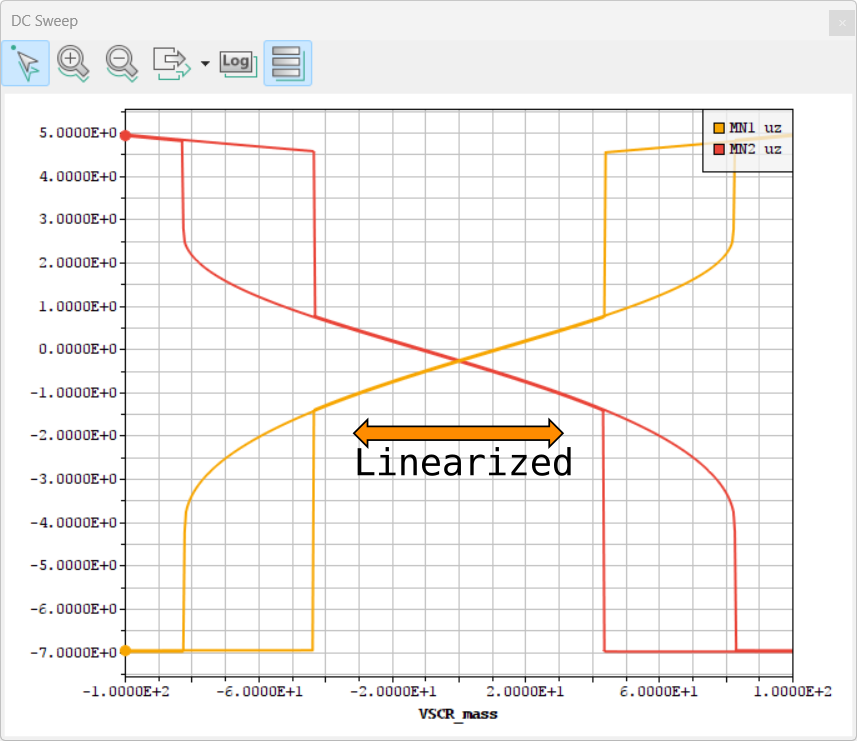
Linearized uz-displacement
|
Table 2. Voltage-tilt-relationship of the mirror at different operating conditions.
Alternatively, both capacitors are utilized for electrostatic actuation as shown in the right column of Table 2. Two DC-voltages of different sign are applied at the bottom plate conductors referred to as bias voltages. The drive voltage is applied at the functional layer and forms a differential capacitor. DC-sweep results show that the voltage-tilt-function is linearized for driving voltages between -40 V and +40 V. Another advantage is that the mirror tilts in both directions depending on the sign of the applied voltage. The system is linearized in the operating range.
The voltage-tilt-functions in Table 2 are created by the “DC Sweep” features of the GUI. Motion DOF results can be visualized at the rigid body center points (RB), at master nodes (MN) and spring connecting points (SL). Furthermore, DC-sweep results can be animated with the “3D View” panel icons. For above examples, an amplitude scale factor of 30 should be set in the “General Plot Controls” panel.
Static simulations analyze the quasi-static response at low frequencies. It is also possible to estimate the behavior at resonance for the first eigenmode by scaling data with the quality factor. However, the current example operates at the second eigenfrequency which can only be analyzed in a harmonic or transient simulation as shown in the following.
Harmonic response analysis (AC-sweep)⚓︎
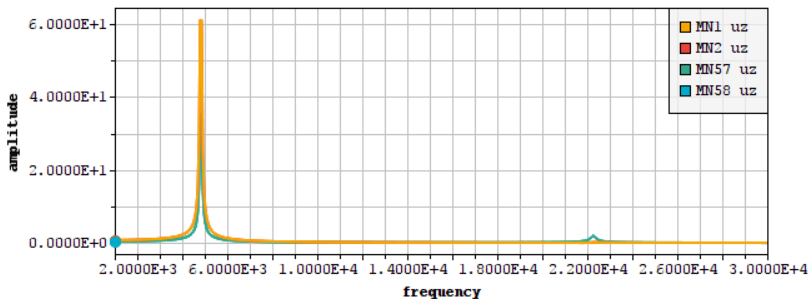
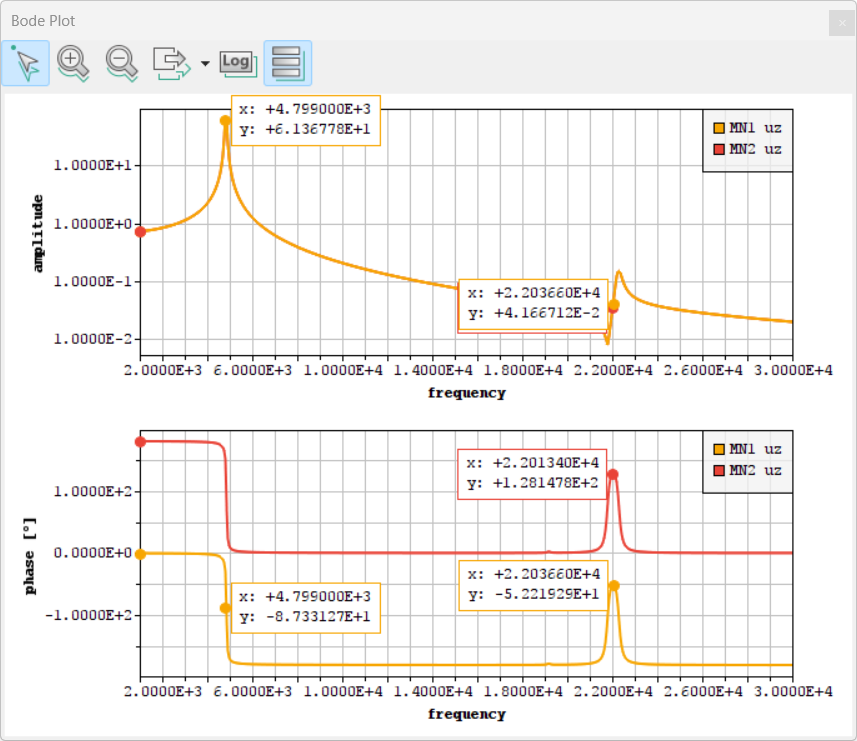
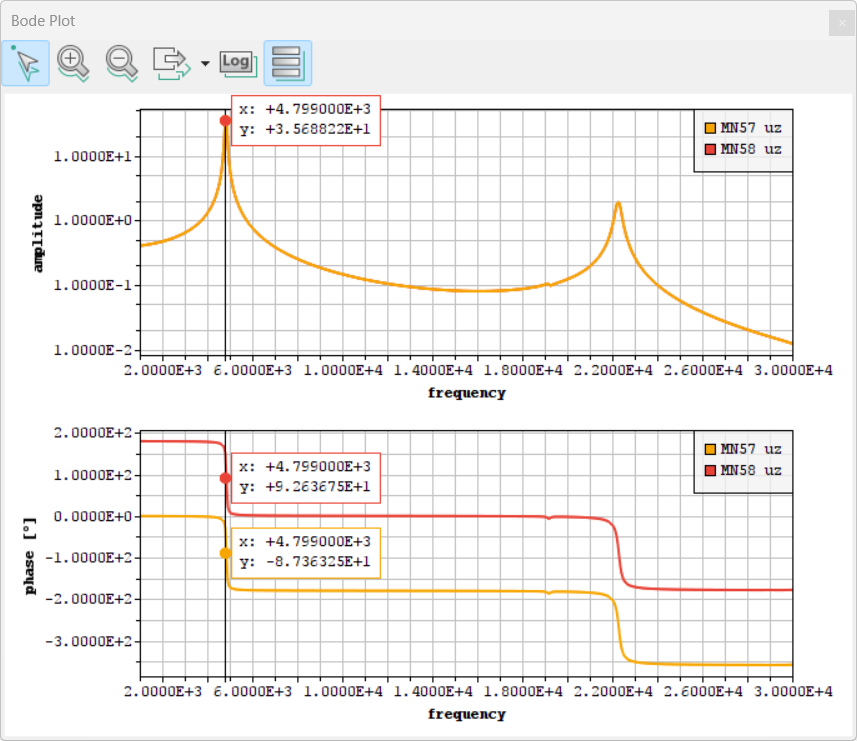
The “Harmonic response analysis” in Table 3 calculates tilt amplitudes and the phase angle in a frequency range from 1 kHz to 30 kHz with 5 thousand steps. It takes just a few seconds on a PC. The right upper amplitude-frequency-plot shows the strong resonant amplification close to the first eigenmode. Linear axis scaling is usually not appropriate for high quality factors. The response curves below use logarithmic scaling for the y-axis. Logarithmic axis can be activated by the “LOG” icon in the "Bode Plot" panel of the Graphical User Interface. Clicking on the LOG-icon toggles between four combinations of the x-y-axes scaling (lin-lin, log-lin, lin-log and log-log referred to as Bode plot).
The left curves in Table 3 show the frequency response of the actuator mass (mn1 and mn2) and the right curves the response of the optical mirror (mn57 and mn58). Tilt amplitudes at the eigenfrequency of 4.8 kHz are 61 mrad for the actuator mass and 36 mrad for the mirror mass.
An anti-resonance can be observed at 22 kHz which cancels tilt-displacements at the actuator mass by about 60 dB (3 decades) compared to the tilt at the operating frequency. There are ideas to use anti-resonance for driving mirrors because the amplitude ratio between inner and outer mirror is extremely high.
Unfortunately, there is no resonance amplification and the overall performance is not as good as using an eigenmode for operation. The anti-resonance can be considered as the cut-off-frequency where the micro mirror turns from the in-phase oscillations (0° phase difference) to the anti-phase oscillations (180° phase shift) which can be seen in the phase-frequency-response of Table 3.
|
Tilt amplitudes at the inner and outer mass verse frequency:
|
Master node displacements of actuator mass:
|
Master node displacements of inner mass:
|
Table 3. Harmonic response analysis results of the micro mirror example.
Transient simulations⚓︎
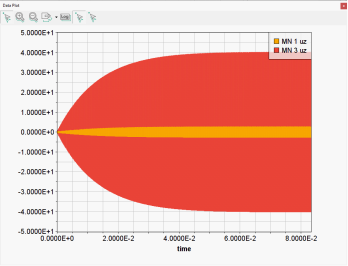
“Transient simulations” analyze the structural response in the time domain. The example in Table 4 uses the same input parameters as set in the previous harmonic response analysis. The mirror is driven at 24 kHz by sinusoidal voltages and stationary state amplitudes are compared with AC-sweep result data.
The quality factor of the operating mode is 1000. The settling time (95 % of peak value) is about 1000 cycles. In order to reach the stationary state, 2000 cycles will be analyzed in the following example. Hence, the total simulation time is 83 ms. Oscillators with high quality factors need smaller time steps compared to systems with moderate or optimal damping. For this reason, 150 steps are set for each cycle. It corresponds to a time-step size of 0.28 µs.
|
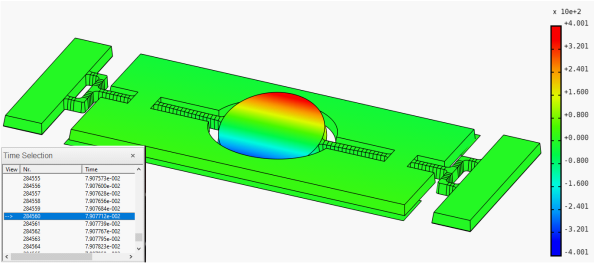
Displacements in uz-direction at the specified sample:
|
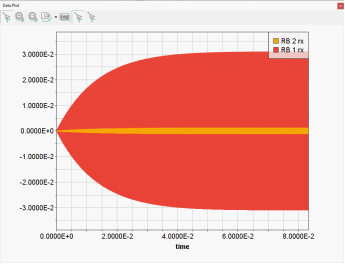
Tilt angle over time for both mass bodies:
|
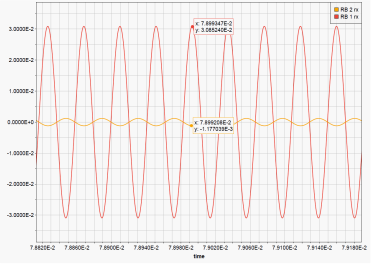
Zoom into the transient response:
|
uz-displacements at master nodes over time:
|
Zoom into the transient response:
|
Table 4. Transient simulations of the settling time at sinusoidal voltage loads.
In total, 300 thousand time-steps are necessary to run the example in Table 4. It takes about 10 minutes on a PC. Exported SIMULINK models are usually faster because special solver provide an excellent performance for stiff differential equations which usually occur for MEMS applications (see Interface to SIMULINK®).
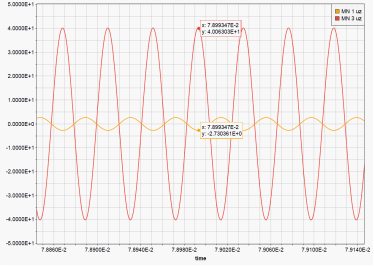
The second row in Table 4 shows the transient response for rx-tilt of the inner and outer mirror. Amplitudes are 30.8 mrad and 1.17 mrad which corresponds to results of the harmonic response analysis. Master node amplitudes are 40.1 µm and 2.73 µm at the outer edges of the mirror. The red and orange data point markers of the “Time Response” panel show the DOF-label (RB 2 ux), the x-axis value which is the time, the y-axis value which is the tilt angle in rad and the sample index.
Sample #284,560 with peak displacements has been selected in the “3D View” panel to show the structural displacements at a snapshot in time. The upper right picture of Table 4 shows uz-displacements at 79.07 ms which have been enlarged by a scale factor of 10 for better visualization.
Interesting is the time domain animation of the structural response. It takes several hundred cycles until the anti-phase motion can clearly being observed. The left plot in Figure 3 shows the rx-tilt response for the inner and outer mass. At the beginning of the simulation are strong interference patterns which slowly disappear. Likewise, there are out-of-plane motion components caused by the DC-bias voltages which are switched on at the initial time-step. Vertical electro-static forces pull the masses downwards and cause oscillations in uz-direction as shown in the right plot of Figure 3.
In order to animate the transient response, select the first time-step in the “Time Selection” window, then set the scale factor of the “General Plot Controls” window to 1000 to enlarge motion components for better visualization and finally adjust the orientation of the mirror model to get the best view. Click on “Start animation” in the “3D View” window. After larger deflections have reached, the scale factor can be reduced accordingly to a final value of about 30.

Figure 3. Interferences of motion components at the beginning of the simulation.